Rendition meaning refers to a particular version or interpretation of something — most commonly a performance, translation, or rendering of an original work. A singer’s rendition of a song is their own take on it, distinct from the original recording. The word also has more specific legal, architectural, and literary uses, which this guide covers in full, along with practical examples showing exactly how each context changes the way the word is understood. For more insights, read here:- goodfella meaning and pegged meaning.
- The Direct Rendition Meaning
- Origin and Etymology Behind the Rendition Meaning
- Rendition in Music, Theater, and Art
- Rendition in Translation and Literature
- Rendition in Architecture and Design
- Rendition vs. Rendering: Is There a Difference?
- Rendition in Legal and Diplomatic Contexts
- Is Rendition a Formal Word?
- Common Misunderstandings About the Rendition Meaning
- Similar Words to the Rendition Meaning
- Well-Known Types of Renditions
- How to Use the Rendition Meaning in a Sentence
- Frequently Asked Questions
- What does rendition mean in simple terms?
- Is rendition the same as a cover song?
- What is an architectural rendition?
- What does rendition mean in a legal context?
- Is rendition a formal or casual word?
- Can a rendition be considered better than the original?
- Does rendition always mean something musical?
- What's the difference between a rendition and an adaptation?
- Conclusion
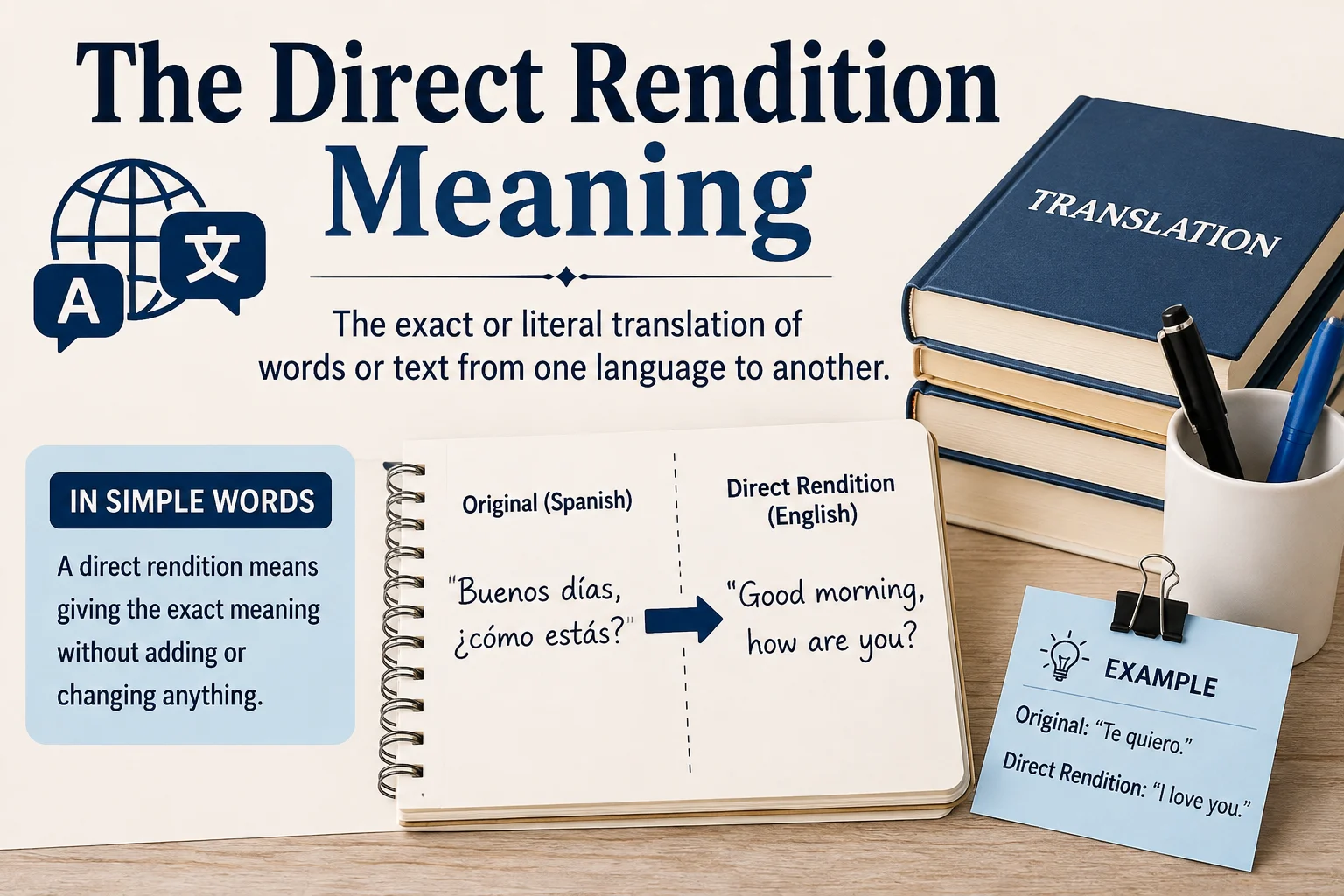
The Direct Rendition Meaning
At its simplest, the rendition meaning describes how something is presented, performed, or translated by a particular person. If two musicians play the same song, each performance is a separate rendition, even though the underlying song is identical. The word highlights the performer’s or translator’s individual choices — tone, style, phrasing, or interpretation — rather than the original source material itself.
This is why the rendition meaning is often paired with a possessive: “her rendition,” “his rendition,” or “a jazz rendition.” The word draws attention to the interpreter, not just the content being interpreted.
Origin and Etymology Behind the Rendition Meaning
Rendition comes from the older verb “render,” which itself traces back to Old French “rendre,” meaning “to give back” or “to give up.” Over time, “render” picked up the sense of “to present” or “to represent,” and “rendition” developed as the noun form describing the act or result of rendering something.
Because language change happens gradually and record-keeping from earlier centuries is incomplete, the exact point at which “rendition” took on its modern performance-related sense is uncertain. What’s clear is that the core rendition meaning — presenting or interpreting something — has stayed consistent for a long time, even as new specialized uses have been added around it.
Rendition in Music, Theater, and Art
The most common everyday use of the word appears in music and performance. A “rendition” of a song, poem, or play refers to how a specific performer delivers it. Two singers covering the same classic song might produce completely different renditions — one slow and emotional, another upbeat and energetic — while the lyrics and melody stay the same.
This sense of the rendition meaning extends to theater and film as well. An actor’s rendition of a well-known character, or a director’s rendition of a classic story, describes their particular creative interpretation. Critics and audiences often compare renditions directly, discussing which interpretation feels more faithful to the source material and which takes the most creative liberties.
Example: “Her rendition of the national anthem brought the entire stadium to its feet.”
Renditions are often compared directly against one another, especially in competitive settings like talent shows or classical music competitions, where judges and audiences weigh interpretation, technical skill, and emotional delivery side by side. A single well-known song might accumulate dozens of distinct renditions over the decades, each reflecting the era, genre, and personal style of the performer behind it.
Rendition in Translation and Literature
The rendition meaning also extends into translation and literary work. When a translator converts a poem, novel, or speech from one language into another, the result is sometimes called a rendition rather than a strict translation, especially when the translator prioritizes tone, rhythm, or emotional impact over word-for-word accuracy.
This distinction matters because a literal translation and a rendition can differ noticeably. A literal translation aims to preserve exact wording, while a literary rendition aims to preserve the feeling and intent of the original text, even if that means changing specific words or phrasing along the way. Translators of poetry, in particular, often describe their work as a rendition precisely because so much creative judgment is involved in deciding what to keep, adapt, or leave out.
Rendition in Architecture and Design
In architecture, design, and visual art, a “rendition” can also refer to a visual representation of a planned project — sometimes called a “rendering.” An architect’s rendition of a new building shows what the finished structure is expected to look like before construction begins. This use of the rendition meaning shifts slightly away from performance and toward visualization, but the underlying idea is the same: someone is presenting their interpretation of something that isn’t fully realized yet.
Interior designers, product designers, and even video game developers use the word the same way, producing renditions of spaces or objects that clients can review before final production.
Rendition vs. Rendering: Is There a Difference?
“Rendition” and “rendering” overlap significantly, especially in visual and architectural contexts, which leads many people to wonder whether the two words are interchangeable. In most everyday design conversations, they are treated as synonyms — an architect might casually say either “rendition” or “rendering” to describe the same digital preview of a building.
Technically, “rendering” more often refers to the process of creating that visual, particularly in computer graphics, where “rendering” describes the software step of generating an image from a 3D model. “Rendition,” by contrast, more often refers to the finished result or the broader idea of an interpreted version, whether visual, musical, or textual. In practice, though, this distinction is fairly loose, and the rendition meaning in casual design conversation usually lines up closely with how people use “rendering.”
Rendition in Legal and Diplomatic Contexts
Outside art and performance, “rendition” also has a distinct legal and political meaning. In this context, rendition refers to the formal transfer of a person from one jurisdiction to another, typically to face legal proceedings. This use of the word predates its more casual meaning in some legal traditions and remains active in extradition and criminal law today.
A more specific and widely discussed term, “extraordinary rendition,” refers to the transfer of a suspect between countries outside standard extradition procedures. This practice has been the subject of significant public debate and criticism, particularly regarding due process and human rights concerns raised by journalists, human rights organizations, and government oversight bodies. Because this is a sensitive and heavily reported topic, specific claims about individual cases, legality, and government policy should be verified against current, reliable reporting rather than assumed from general usage.
It’s worth noting that this legal sense of the rendition meaning is unrelated to the artistic sense — the word simply developed two separate specialized meanings over time, both rooted in the general idea of “presenting” or “handing over” something.
This split between the artistic and legal senses of rendition is a good reminder that many English words carry multiple, unrelated definitions that happen to share a spelling and a distant historical root. Readers researching the rendition meaning for a legal report, a news article, or academic writing should be especially careful to specify which sense they mean, since the artistic and legal uses can create confusion if the surrounding context isn’t clear.
Is Rendition a Formal Word?
Rendition sits on the more formal end of everyday vocabulary. It shows up often in music reviews, art criticism, architectural presentations, legal reporting, and academic writing. It’s less common in casual texting or social media slang, and there’s little evidence it functions as internet slang in the way some other words do. When people do use it casually, it’s almost always still tied to one of its established meanings — a performance, a design mockup, or occasionally a joking reference to someone’s “rendition” of a task done their own particular way. This formal-leaning tone is part of why the rendition meaning tends to show up more in written reviews and professional presentations than in quick, casual messages between friends.
Common Misunderstandings About the Rendition Meaning
One common mix-up is confusing “rendition” with “recitation.” A recitation usually refers to reciting something from memory, word for word, while a rendition implies interpretation and personal style rather than exact repetition. A rendition can vary significantly from the source, while a recitation is expected to match it closely.
Another misunderstanding involves assuming rendition always refers to music. While musical use is extremely common, the rendition meaning is broader and applies just as naturally to visual art, architecture, translation, and — in a completely separate legal sense — the transfer of a person between jurisdictions.
A third misunderstanding treats “rendition” as if it always implies a dramatic or highly creative reinterpretation. In reality, the rendition meaning simply requires that a person or group presented their own version of something — the difference from the original can be small or large, and both still count as valid renditions.
Similar Words to the Rendition Meaning
Words with related meanings include “interpretation,” “performance,” “version,” and “rendering.” None of these fully overlap with the rendition meaning on their own. “Interpretation” focuses on understanding and meaning, “performance” focuses on the act of presenting something live, “version” is broader and can apply to almost anything with variations, and “rendering” overlaps closely with rendition in visual and architectural contexts specifically.
Choosing “rendition” over these alternatives usually signals that the speaker wants to highlight a specific individual’s take on something, rather than describing the thing in general terms.
Well-Known Types of Renditions
Renditions show up across a wide range of everyday situations, even when people don’t use the word explicitly. A cover song on a streaming platform is a musical rendition. A movie adaptation of a novel is a narrative rendition of the book’s story. A 3D walkthrough shared by a real estate agent before a building is finished is a visual rendition of the finished property. Recognizing these patterns makes it easier to spot the rendition meaning in contexts where the word itself isn’t actually used, since the underlying concept — someone’s specific interpretation of an original — shows up constantly in everyday life.
How to Use the Rendition Meaning in a Sentence
Because the word covers several distinct contexts, it helps to see it used naturally across different situations. In a music context: “The choir’s rendition of the hymn was slower and more reflective than the original recording.” In an architecture context: “The developer shared an early rendition of the new office tower for public feedback.” In a literary context: “Her rendition of the ancient poem kept its emotional weight even though she reworked nearly every line.” In a legal context: “The case involved the rendition of the suspect to face trial in another jurisdiction.”
Each example uses the same underlying word, but the surrounding context makes the intended sense of the rendition meaning immediately clear to the reader or listener. Paying attention to that surrounding context is really the fastest way to understand which sense of the word is being used at any given moment.
Frequently Asked Questions
These quick answers cover the most common questions people ask about the rendition meaning.
What does rendition mean in simple terms?
The rendition meaning is a particular version, performance, or interpretation of something, especially a song, artwork, translation, or design.
Is rendition the same as a cover song?
Not exactly. A cover song is one type of rendition — specifically a musical one — but the rendition meaning also applies to art, architecture, and legal contexts that have nothing to do with music.
What is an architectural rendition?
An architectural rendition is a visual representation of a planned building or space, showing what the finished project is expected to look like before it’s built.
What does rendition mean in a legal context?
In legal and political contexts, rendition refers to the formal transfer of a person from one jurisdiction to another, often connected to extradition proceedings.
Is rendition a formal or casual word?
It leans formal. It appears frequently in reviews, legal reporting, and design presentations, and less often in casual texting or slang.
Can a rendition be considered better than the original?
Yes. Because a rendition reflects personal interpretation, audiences and critics often judge some renditions as more compelling, creative, or technically impressive than the original version.
Does rendition always mean something musical?
No. Although the rendition meaning is most commonly associated with music, it applies equally to translation, architecture, visual art, and the separate legal sense involving the transfer of a person between jurisdictions.
What’s the difference between a rendition and an adaptation?
An adaptation usually changes the format or medium of a work — turning a book into a film, for example — while a rendition typically keeps the same format but reflects a new performer’s or creator’s personal interpretation.
Conclusion
The rendition meaning ultimately centers on interpretation — a specific person’s or group’s way of presenting, performing, translating, or visualizing something that already exists in another form. Whether it’s a singer reimagining a classic song, a translator reworking a poem, an architect previewing a future building, or a legal term describing the transfer of a person between jurisdictions, the word always points back to one core idea: someone’s particular version of something. Keeping that core idea in mind makes it much easier to understand the rendition meaning correctly no matter which context it shows up in.